

There’s always that moment—usually around week two of a greenfield project—when someone gets starry-eyed and says, “What if we just let AI write the protocols?”
Cue the collective nods. Cue the excitement. Cue… the same old paper-based FAT, SAT, and Excel punch list.
Let’s be honest: AI-generated anything sounds sexy. But in our world—where a missing material certificate or mislabeled valve can mean days of delay, and where compliance doesn’t care about your cool new tool—it’s not quite that simple… or are we trying to hard?
So here’s a field note from the frontline of pharma project delivery: digital tools in hand, feet still firmly on the factory floor.
From Punch Lists to CAPA: A Tour of the Project Lifecycle
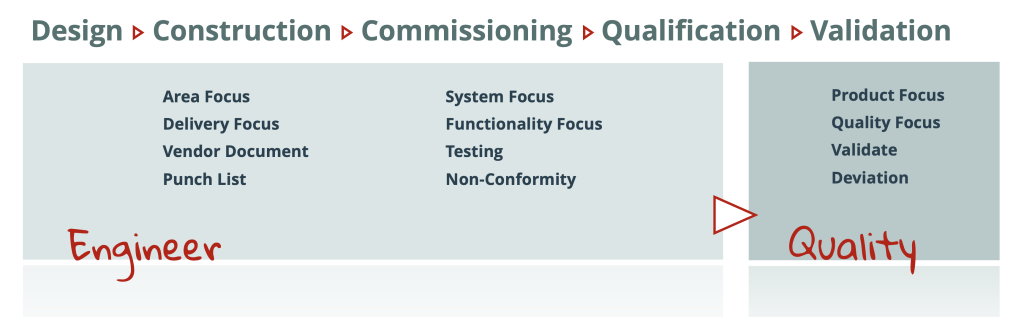
Early-stage projects? We’re in punch list territory. These are quick fix—missing a tag, fixing a dent, and moving on. Minimal effort, minimal drama. But that simplicity ends the moment we shift from area-focused to system-focused thinking.
When we reach commissioning and qualification, we start thinking in systems: WFI generation, clean steam, Grade A zones. And the documents? They stop being checklists. They become functional tests. Is it working as intended? Is it really?
At that point, we don’t just “retest until it passes.” We investigate, correct, document—and only then retest. Because a failure here isn’t just a delay. It’s a risk. And when we move to validation, that risk has a name: patient safety.
In the final testing phase—process validation—we crank things up. We move from non-conformity to deviation. After all the effort invested in design, construction, commissioning, qualification, and GMP readiness, if you can’t achieve the expected result, you need to ask yourself some serious questions. Why is it going wrong? At this point, we’re product-focused and getting ever closer to delivering the drug to the patient. Assurance of quality output can’t rely solely on testing.
Before AI, Think Digital: One Size Doesn’t Fit All
Trying to digitalize an entire project lifecycle? Ambitious. Necessary. But tricky.
Each phase of the project has its own focus, its own stakeholders, and its own ideal tool. Punch list management, qualification workflows, validation protocols—none of them benefit from a “one-software-to-rule-them-all” approach. Trust me, we’ve tried.
That’s why we still want specific tools for specific tasks. A hammer won’t fix every problem.
- A punch list tracker that filters by vendor or area? Yes, please.
- A qualification tool that encourages root cause thinking before closing a non-conformity? Absolutely.
- A CAPA system that can hold off badge access and track recurrence? Essential.
Integration matters. But specialization wins.
Your job? Think about how data flows from one system to another. Configure tools to support the next phase. Avoid data duplication. Be smart. Structure your data when it matters.
The AI Hype Curve Is Real (and Brutal)
Here’s how it starts: You discover ChatGPT. You dream big.
Auto-generated protocols. Machine-learning thermal mapping. Zero deviations forever. Let the bot do the job.
A week later: nothing works. You’ve wasted time and money. Your dream AI project? Dead on arrival. But then something shifts. You learn. You adapt. You start building, not fantasizing.
That’s when the real AI journey begins.
Be pragmatic. Be bold. Be optimistic. Be careful.
At No Deviation, we tried everything. We built our own GPT-based chatbot from scratch (with help from some brilliant minds in Poland). We quickly realized: we’re not OpenAI, and we’re not trying to be. So we pivoted. Our goal? Be the best user of AI, not the best builder.
So… Does AI Actually Help?
Yes. But also no. It depends. (Classic pharma answer, I know.)
We tested three models:
- ChatGPT (v4)
- DOC-GPT (our bespoke AI trained only on GMP docs)
- The ISPE Forum (because, well, real humans still matter)
We took a real-world GMP question, asked all three, and compared:
- ChatGPT gave a quick, confident answer—sometimes off-base, but often surprisingly helpful, especially when external references were cited.
- DOC-GPT stuck to the documents. Great when the answer was there. Useless when it wasn’t.
- The ISPE Forum asked follow-up questions. Like any good SME would. Because the answer depends on your context.
The Real Lesson? It’s Not the Answer, It’s the Question
The real value wasn’t in the AI output. It was in reclassifying the question.
If we understood the context—why the question was being asked—we could guide users to the right document, the right insight, the right expert.
That’s the hard part. And that’s where AI still needs us humans.
Wrapping Up: No, AI Won’t Save You (But It Might Help)
Digital transformation in pharma isn’t about dreaming. It’s about doing.
It’s punch list to patient. It’s protocol to product. It’s people before platforms.
And it’s not about AI taking over the project—it’s about using the right tool, for the right phase, in the right way.
If we can do that? Then maybe, just maybe, AI won’t write our protocols for us… but it might help us write better ones.
What We’re Actually Achieving with AI
- Expedited design reviews using AI tools
- Focus on building test case libraries (Use AI to collate them)
- AI-assisted material verification instead of manual checks
- AI-based formatting—because tuning a model is easier than training 100 engineers to be consistent
- Automated summary reports
- Regulatory chatbots to improve procedural literacy, training uptake, and engagement
Interested in boosting your team with these tools? Let’s talk. Let’s share. Let’s evolve.
